TWINFALL at InNoPor 2025: advancing landslide simulation techniques
On October 17th, 2025, the TWINFALL project was represented at the InNoPor Workshop in Kiel, Germany. Luca Formaggia from the MOX Laboratory (Department of Mathematics, Politecnico di Milano) delivered a presentation titled “A material point method technique for landslide simulation,” highlighting critical advancements in how we predict and model hydrogeological disasters.
The presentation outlined the latest developments in numerical methods designed to provide fast, reliable, and highly accurate scenario analyses for landslide runouts and rock-fall triggering.
Key methodological innovations that were illustrated during the workshop:
- Depth-Averaged Material Point Method (DAMPM): The research showcased a semi-Lagrangian scheme that acts as a faster, computationally cheaper alternative to full 3D models while naturally handling complex geometries derived from satellite images.
- Performance boosts: The new DAMPM solver demonstrated a computational speedup of approximately 2.6 times compared to previous mesh-based methods.
- Future-proofing: The team is actively working on GPU porting for these simulations, which has already shown speed-ups of up to nearly 6 times on preliminary tests.
- Multiscale coupling: The presentation introduced ongoing work to couple 2D depth-averaged simulations with full 3D Material Point Method (MPM) simulations to handle complex interactions, such as landslide impacts against protective barriers.
A major highlight of the talk was the application of these models to real-life scenarios, directly tying into the core mission of the TWINFALL project:
- Historical validation: The models were successfully tested against the 2002 Bindo-Cortenova translational landslide and the 2015 Rochefort Torrent debris flow in the Aosta Valley, proving their reliability against empirical surveys.
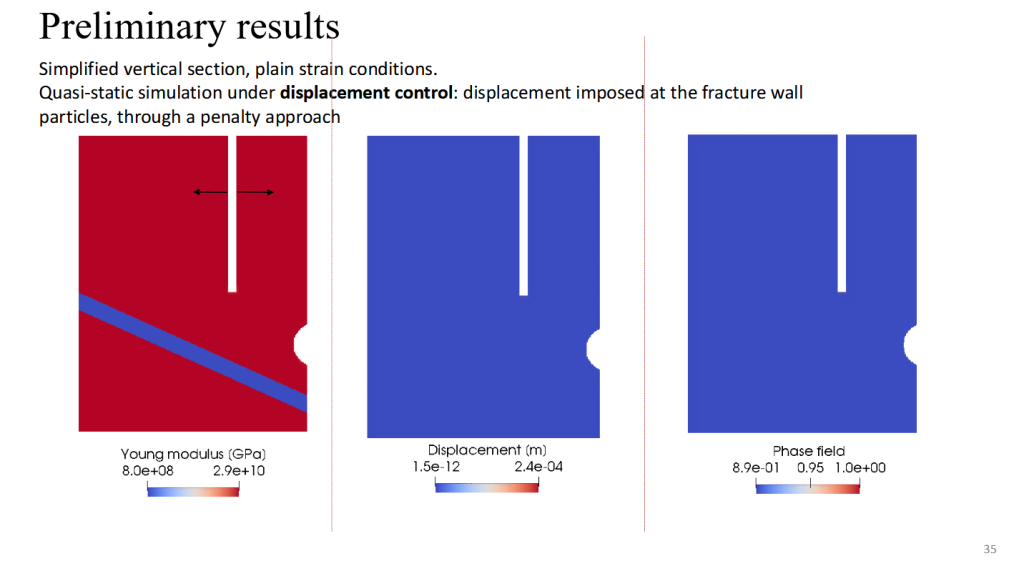
- Torrioni di Rialba: Crucially for the TWINFALL initiative, the presentation detailed a phase-field MPM approach to model rock-fall triggering at the Torrioni di Rialba in Abbadia Lariana.
- Predicting fractures: This specific model aims to simulate how fractures propagate through the rock formations in response to triggers like pore water pressure or vibrations from nearby highways and railways.
The research presented in Kiel represents a significant step forward in building the predictive “Digital Twins” at the heart of our initiative. The work was supported by the Fondazione Cariplo TWINFALL Project, alongside partners such as the Italian Space Agency (ASI) and the National Research Center in HPC, Big Data, and Quantum Computing (ICSC).